Posts

Showing posts with the label scout rifle

Two cures for scout scope glare

Some riflemen find that the scout scope (forward-mounted scope sight) becomes a problem when the sun is low and behind them. The sun causes glare in the scope. I have two solutions, either of which solves the problem. Either Put a lens hood on the back (ocular) end of the scope Or Wear a broad-brimmed hat. So much for the main objection to the forward mounting position for your optic. A lens hood is ordinarily seen on the front of an optical system, for the purpose of eliminating glare when bright light strikes the lens from an angle, but there is no reason it cannot serve the same purpose on the back end. You may need to improvise a suitable hood, but it is a simple project. As to hats, I am comfortable in a Stetson, but if your favorite boots have shoelaces you may feel differently. A Smokey the Bear hat will work, or a felt crusher. You could rock the safari retro style and wear a pith helmet...

"California kneeling" rifle position

The so-called California kneeling position, known also as double kneeling,  places both of your knees on the ground. It is great for field rest shooting. By field rest, I mean improvised firing positions in which you lean over a solid and steady object or lean up against one. You can easily adjust the height of the California firing position to shoot leaning over a rest such as a boulder or a fallen tree, or as easily lean your body slightly to one side to gain support from a vertical object such as a fence post or a wall. You would not ordinarily adjust by leaning backward, for bending forward is more natural and better balanced, yet the occasional situation might call for a backward lean, such as needing to shoot at an upwards angle. Because of its great adaptability to the height of the field rest and the target elevation angle, California kneeling is useful with nearly any rest you find. If you cannot find a field rest, you can shoot from California kneel...

Red dots and bolt actions

Image
The way I set up a lightweight bolt action sporter rifle is to mount a red dot sight, micro size, on the receiver ring. The sight is not in the way of loading the magazine, cycling the bolt, or clearing a jam. The sight picture is instantaneous when you raise the rifle. The rifle is light and well balanced in the hands, making it quicker to the first well-aimed shot than typical semi-automatics. I do not regard backup iron sights as essential. A spare optical sight is at least as good to have instead, if it is in some sort of return-to-zero mounting and you have brought with you whatever tools are needed to install it. You should, of course, have spare batteries always on hand for electronic sights. It is best not to trust in the claim that you have years and years of battery life. It may be true, but a defective battery can make nonsense of claims like that. For some riflemen, the backup is a conventional telescopic sight, for they reason that the scope can do some things the dot...

Pearson's No-Drill Winchester Rail Mount

Image
For Pearson's web page, click here. I have not yet had a chance to try one of these scout mounts for the great old Winchester 94, but the system looks stronger and more secure than some of the other efforts to make such things. So I thought I'd place the information out there to see if the rest of you are interested. If you've actually used this system, please leave a comment as to your impressions. The lever .30-30 continues to be one of the best light rifles available, despite being an idea from the century before last. Modern optics only make it better, if you can get them mounted solidly on there.

When is a scout rifle not a scout?

Ruger has announced  that they now offer their Gunsite Scout Rifle in 5.56/.223. This contravenes the scout rifle's very definition, which calls for a full powered cartridge, but it will prove a fine rifle none the less--nearly recoilless, cheap to feed, handy and accurate. When Steyr introduced a scout rifle in the same caliber, Col. Cooper dubbed it the " poodle scout ," and spoke rather scornfully of the idea of a light caliber scout rifle. I see his point of view; such a weapon is useful for fewer things than one chambered for his recommendation, .308. He wanted the scout rifle to be useful for as many things as possible. But we need not be persuaded by his reasoning. A scout in .223 goes against the scout rifle concept, but it is not inherently a bad idea. It would be a great gun for pest control, small deer as found some places in Europe, and likely some other things as well. Of course Cooper was right about the versatility factor. There are varmint loads for t...

The why of the scout rifle

The point of a scout rifle is its versatility. It will do, fairly well at least, as a mountain rifle, plains rifle, brush gun, camp gun, ranch rifle or tactical carbine. There are various rifles that will do any one of these things better, but that is not the point. The point is to get away from specialization, of the kind that requires a safe full of rifles. The scout rifle's lack of extraordinary ability in any area is compensated somewhat by the user's greater familiarity with it, if he really does use it as intended, using it for everything, instead of dividing his time among a collection of rifles. "Beware the man with one gun." That is the matter as I understand it. The scout rifle concept would catch on quicker if there weren't all those millions of lever .30-30's already out there,  giving good service. For a long while the lever gun was the most versatile light rifle going, and in some minds it still is. It is a hard sell to convince the .30-30 m...

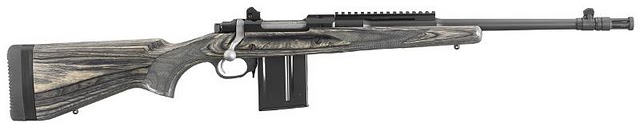
A new scout rifle from Ruger -- and it looks good

Image
Check this out at Ruger Firearms News . Ruger has repented of its lapse in building scout rifles and come up with a new model that is interesting indeed. Until I get gun in hand I won't know all about it, but it is an M77 with--get this--a detachable box magazine holding 10 rounds, ear-protected front sight, rear 'ghost ring' peep sight and a rail for whatever long eye relief optic you like. The new rifle is called the Ruger Gunsite Scout because Gunsite Ranch and Ruger collaborated on the specs. Photo  © Sturm, Ruger & Co. Used by permission Now, this is a brand new announcement, dated today, and we have all seen guns announced that never materialized. I have high hopes for this one, though. We will have to wait and see about the questions of price, availability, reliability and accuracy, with reliability being a key concern. A number of manufacturers have muffed the question of making detachable magazines work properly in bolt actions. Ruger, though, has a co...

Future Rifle

The scout rifle was a good attempt, thirty or so years ago, to come up with the ideal all-around rifle. How well it succeeded is open to debate. In any case, enough time has passed to ask what we have learned and where we go from here--how to make an even better general purpose rifle. In the Americas, at least, the all around rifle was for a long time the .30-30 lever action, and for many people it still fills that role just fine. It is compact, fast handling and convenient. Its accuracy, range and power are not all that might be wished, but good enough for a whole lot of uses. Self defense, pest control, deer hunting, or just a bit of fun at the target range, the .30-30 has it covered. Then, at least for people who felt they needed something better than the .30-30, the general purpose rifle became the scout, or other full powered carbine with a bolt action. The bolt action's power to weight ratio and durability afield, its potential for fine accuracy and its proven reliabilit...

The Art Of The Rifle, by Jeff Cooper

Image
There are many books about how to shoot a rifle. There are some excellent ones written about target competitions and how to win them. There are also many military manuals explaining the rifleman's role in combat.   The Art of the Rifle  is something else again. It takes up the general subject of field marksmanship, whether for hunting or fighting, which may be summed up as the problem of addressing fleeting targets. Accuracy is essential, of course, but Cooper also underlines the need for all practical speed. I was, therefore, surprised to see a detailed treatment of the formal firing range positions--prone, sitting and so on, and the use of the sling. But there is an unusual wrinkle here, the use of a "speed sling" to get you tied to the rifle faster than is possible with the traditional loop sling. The problem of adapting the target range positions to field conditions of terrain and cover is given due treatment, with the suggestion that you may modify the pos...

Sons of the scout rifle

Image
Col. Jeff Cooper was an enthusiastic booster of several innovations in guns and shooting. Notable among them was the 'scout rifle,' short, light and yet powerful and accurate -- a .308 carbine. Bolt action, because a field-tough .308 autoloader action was heavy. A bolt action can be built very light for the power it commands, and still be very durable. What I want to look at in this posting is what has become of the scout rifle concept in the thirty or so years since Cooper dreamed it up, and where we go from here in the search for an even better all around rifle. Cooper thought the scout an ideal general purpose rifle, useful for just about anything you would need a high powered rifle for, and exceptionally convenient. His idea did not catch on like wildfire. Just two manufacturers offer scout rifles, Steyr Mannlicher and Savage. Ruger has lately dropped out of the race. Some custom gunsmiths will build you a bespoke scout if you like. Here is what a scout looks like...