Posts

The "nudge" trigger release

The "nudge" method of pulling a trigger is an alternative to the standard "surprise break" method. In almost every case, the "surprise break" trigger stroke is the best way to fire an accurate shot. This is the standard method taught to generations of hunters, target shooters and soldiers: Apply pressure on the trigger progressively until, at a moment not of your choosing, the gun fires. You don't make it fire, you let it fire, as if by itself. As I explain elsewhere , if you do not know the exact instant the shot will fire, you will not know when to respond to the shot being fired. In other words, you will not know when to flinch. So you won't; the gun stays on target as the shot is triggered. That is the purpose, and whole point, of the surprise break trigger stroke. There is another way to manage the trigger. The goal is the same, to make the gun fire at a moment not selected consciously, but the thing is gone about differently. This other...

Classic Gun Review: Original Model Smith and Wesson 586 .357 Magnum

Image
I like automatic pistols just fine. I have shot quite an assortment of them and own some nice ones. But, as I have mentioned elsewhere , I find the double action revolver  a friendlier piece of machinery, more convenient all around. A wheel gun is adequate for most purposes, so that is what I'll reach for most every time. Someone, though, thought this old S&W an inadequate weapon and obsolete; it was a police trade-in from the era when departments in droves were abandoning their revolvers and buying automatics. Those were great days if you liked revolvers; you could get good ones very cheap. This one sold off cheaper than most. It had big patches of holster wear on barrel and cylinder, down to bare pitted metal, and there were some stains and rust freckles in the bluing that remained. The wooden grips were chipped and the varnish was peeling off of them. Obviously this was a gun that had been carried in all weathers for years, but examination showed it ha...

The Art Of The Rifle, by Jeff Cooper

Image
There are many books about how to shoot a rifle. There are some excellent ones written about target competitions and how to win them. There are also many military manuals explaining the rifleman's role in combat.   The Art of the Rifle  is something else again. It takes up the general subject of field marksmanship, whether for hunting or fighting, which may be summed up as the problem of addressing fleeting targets. Accuracy is essential, of course, but Cooper also underlines the need for all practical speed. I was, therefore, surprised to see a detailed treatment of the formal firing range positions--prone, sitting and so on, and the use of the sling. But there is an unusual wrinkle here, the use of a "speed sling" to get you tied to the rifle faster than is possible with the traditional loop sling. The problem of adapting the target range positions to field conditions of terrain and cover is given due treatment, with the suggestion that you may modify the pos...

Shooting To Live

Image
  A short review of Shooting To Live With The One Hand Gun , by W.E. Fairbairn and E.A.  Sykes Though it was published in 1942, there is a great deal in this book that is still of relevance to the practical shooter. Parts of it contain the earliest treatments in print of some pistolcraft concepts that are in use today. It was written by W.E. Fairbairn and E.A.Sykes. Many will recognize their names. They taught close quarters combat to British and American commandos and clandestine operations units, in the Second World War. They taught a collection of oriental-flavored martial arts techniques summed up in the book  Get Tough , the use of the famed Fairbairn-Sykes fighting knife, and other alarming skills. The two learned their trade, pre-war, in the Shanghai Municipal Police, fighting vicious criminal gangs in a  notably dangerous place and time. They discovered, by examining departmental records,  that most police gunfights ...

The NRA Firearms Assembly Books

Image
The NRA Firearms Assembly books are essential classics for gunsmith or tinkerer. There are two volumes, one covering pistols and revolvers , the other, rifles and shotguns . You get exploded schematic views and detailed instructions on how various guns are put together. I've had recourse to these volumes for years to clean, repair or simply understand various arms. All the old favorite guns are here, plus some exotic and seldom seen ones. By including a number of oddball pieces, the books indirectly teach a lesson in firearms technology and history. There are many problems in physics and mechanics involved in making a gun, and some answers are better than others. Simpler is usually better, and some mechanisms passed over by history have indeed deserved it. But, if you happen to have a Frommer Stop, a Johnson or a Visible Loader, you may want to know how it goes together and how it works (when it does). Of value to the curiosity collector, there is a table in the back that relate...

A Rifleman Went To War, by H.W. McBride

Image
I'm starting today to review some notable books on guns and shooting. First up is Herbert McBride's A Rifleman Went to War . This is an old classic that has been republished at intervals since it first appeared in 1935. It is the memoir of an American rifleman who joined the Canadian Army to get into World War One sooner. He got plenty of what he was looking for. As a memoir it is not very good. It is repetitious, filled with digressions and in places pursues minor points at great length. Read another way, though, the book is a gold mine. It is filled with insights about sniping and combat shooting that can occur in only one way: You put an expert shot into the thick of war and see how things turn out. What works? What doesn't? Here are insights on marksmanship and weapons, and on training versus reality, that can arise in no other way. Something sure to be of professional interest today: McBride, all those years ago, distinguished the difference between sniping from ...

A moldy oldie review: The Singlepoint sight

Image
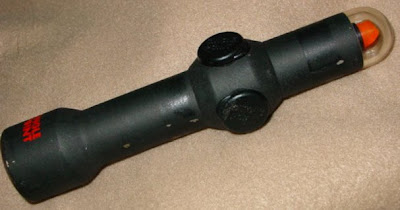
"I don't know just what it is, but I'll let you have it cheap." So said the fellow at the gun show, and that is how I came to have this thing in my collection. The Singlepoint is an ancestor of today's red dot sights. It created a stir back in the seventies. It was discussed in the English  Parliament . Its moment of fame came on the Son Tay  raid in the Vietnam war. It even got writeups in  Popular Mechanics  and  Popular Science , honors reserved for things that were maximally cool. By modern standards, though, it's a pathetic gunsight. It was a good try for its time, no doubt. It is an occluded eye gunsight (OEG), meaning you can't see through it. When you look in the end you see a black field with a red dot floating in it. You look at the target with your other eye and your brain merges the two images into one. Thus, you see the red dot superimposed upon the target. Well, sort of. It doesn't work perfectly. The effects of  pho...