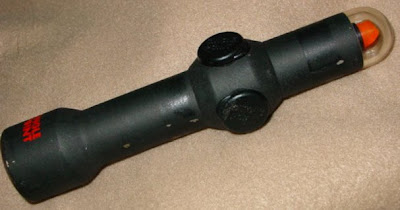
"I don't know just what it is, but I'll let you have it cheap." So said the fellow at the gun show, and that is how I came to have this thing in my collection. The Singlepoint is an ancestor of today's red dot sights. It created a stir back in the seventies. It was discussed in the English Parliament . Its moment of fame came on the Son Tay raid in the Vietnam war. It even got writeups in Popular Mechanics and Popular Science , honors reserved for things that were maximally cool. By modern standards, though, it's a pathetic gunsight. It was a good try for its time, no doubt. It is an occluded eye gunsight (OEG), meaning you can't see through it. When you look in the end you see a black field with a red dot floating in it. You look at the target with your other eye and your brain merges the two images into one. Thus, you see the red dot superimposed upon the target. Well, sort of. It doesn't work perfectly. The effects of pho...
Personally, I like a wide open pattern.The whole reason for preferring a shotgun over a rifle is its hit probability and I don't intend to compromise that. Is it better if your gun throws a broad, open pattern of shot or a small tight one? It isn't a simple question. The shotgun's hit probability, which is superior to any other small arm's at close range, owes to the spread of the shot. If you reduce the spread, you reduce the shotgun's advantage. Things get more complicated, though, when you consider that a pattern that is too wide increases the number of pellets sailing past the target, doing you no good. Since pattern size increases with distance, a loose pattern loses effectiveness rapidly with range as the pattern's density degrades. What to do, what to do? As a sort of baseline to the discussion, the riot gun for its first hundred years or so was almost always cylinder bored or Improved Cylinder choked, and threw open patterns, firing shells concoc...
I have these classic micrometer peep sights on two rifles, at present, and they are good gear! This type of sight has been around approximately forever. The company makes numerous versions to fit a great many firearms. On some guns you will need a taller front sight when you install a peep sight but this is by no means true of all. It used to be old graybeards would look at my peep sighted rifle, nod approvingly and say to me, "See ya got a Foolproof. Good, good..." Now I am the graybeard saying that to younger folks. There is a great deal to approve of. The windage and elevation settings are finely adjustable. They ride on screw shafts and the setting have countable clicks and a visible index. Adjustments are supposed to be in minutes of angle and fractions, but of course that will vary with the length of the barrel, as a matter of simple geometry. Since I have this sight on a rifle that is longer than normal, and on another one shorter than normal, nothing works out to ev...


Comments
Post a Comment